

"How are things different today because of last year's strategy?"
We ask this a lot. Lately, the pause before the answer has been getting longer.
It isn't an awkward pause. It's a thoughtful one. The people we ask run good organisations, full of capable people who worked hard all year. The plan was consultative. It was considered. The board approved it. Everyone meant it. And then the year happened, and urgent, unplanned and thoroughly unstrategic things kept turning up, week after week, until the plan was something people remembered fondly rather than used.
I know that pause from the inside.
In my executive years I watched capable people pour themselves into problems that mattered. We'd fix the supplier. Hit the deadline. Get the operational fire under control. Then the next one would arrive, and it mattered too.
That's what makes it hard. Urgent work is usually legitimate work.
The strange part is that the strategic work was never a mystery. Open the bonnet. Design the ways of working properly. Decide what matters and say so out loud. Fix the operating model so the fires stop lighting themselves. We all knew. We just kept borrowing attention from it, a few hours at a time, to deal with whatever had landed that morning. The work that would have made the next urgent thing less likely was always the work that could wait.
We have tidy names for this now. Tech debt. Design debt. Underneath them all is attention debt, and like any debt, it charges interest.
This is the problem Straforma was built to work on. It's also, I've come to think, the opportunity.
The plan rarely fails in the room. It fails on a busy Tuesday morning.
Strategic drift is attention debt at the scale of a whole organisation.
Nobody decides to abandon the strategy. Nobody has to. Drift lives in the gaps. Between agreeing what matters and choosing what gets attention this week. Between calling something a priority and giving it people, money and time. Between the decision made at the leadership table and the version that reaches the person who actually has to act on it.
No single choice looks like drift. Each one made sense at the time. Add them up and you have the strategy you actually have, as opposed to the one on slide three.
If I spent a week inside your organisation, could I tell what your priorities are?
- The meetings
- The budget calls
- What gets escalated
- What gets dropped
- What people are praised for
Say customer experience is the priority. The leadership team agreed. The board signed off. It's on slide three.
Now it's March, and everything in that panel has happened in the same fortnight.
This is where the real strategy begins.
Do people understand the priority well enough to make those calls without you? Do they know what must be protected and what can bend? Can they disagree in the open, weigh the trade-offs and commit together once the call is made?
Or does every hard choice find its way back to the CEO?
If that last one sounds familiar, it isn't because your people lack judgement. It's because they've never had somewhere safe to use it.
People get better at choosing the way they get better at anything.
By doing it. Getting it a bit wrong. Having another go.
We believe strategy becomes real through choices, not documents. So we built a place to practise choosing.
The Arena is a facilitated simulation. A team makes strategic decisions with incomplete information while the ground moves under them. They decide what matters, where the money goes and what they're prepared to give up. Then they live with the consequences. Then they go again.
It's lively. There's disagreement, surprise and, reliably, a good deal of laughter. People lean in because there's something to do, something at stake and a decision that won't make itself.
It's also revealing. Which assumptions sailed through unchallenged? Whose information changed the decision, and whose never made it to the table? What happened when the clock ran down? Did the team hold to what mattered, or did the latest shiny thing take over?
Those moments are the point. Not because they catch anyone out. Because they're real, they're shared, and they're safe to talk about afterwards.
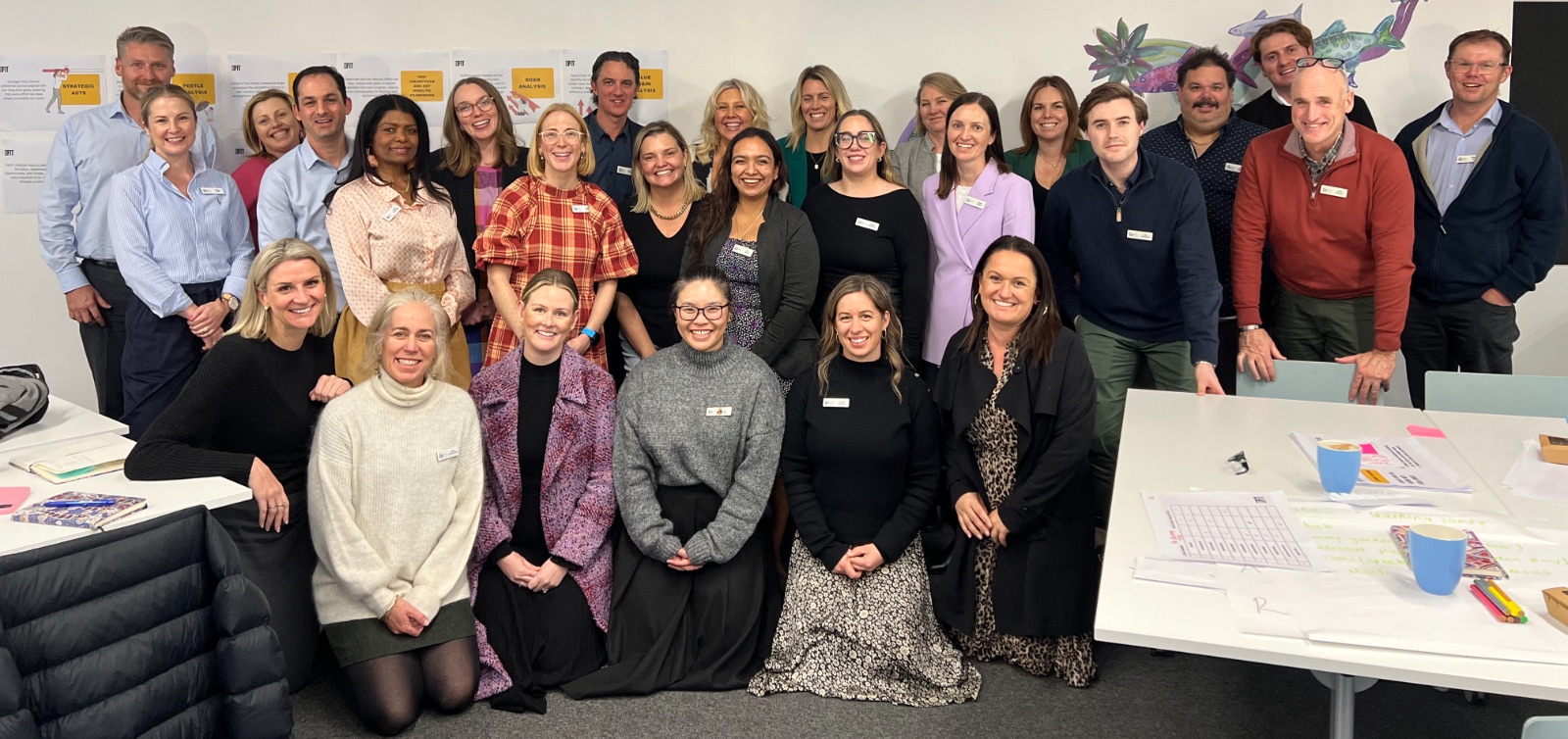
Geelong Chamber Corporate Partners Arena, 2025
Clients run an Arena ahead of their strategy or planning day. The leadership team then walks in with something most planning days lack: a fresh, shared memory of how they actually decide, and a language for talking about it.
"We need to communicate better" becomes a sharper conversation about what information people needed, who had it, and why it never reached the decision.
"We need alignment" becomes an honest look at the different priorities people were quietly protecting without realising it.
The planning day builds on evidence from your own behaviour. Strengths to keep. Habits to question. Choices that need to be made clearer than they are.
It works the same in a business, a public agency or a member organisation, because the questions are the same. What are we here to achieve? What deserves our attention? How will we choose when everything feels important?
A plan tells your team where you're going. Practice is what gets them there when the road changes.
Practise your board's response to an AI incident before you need one.
In June, an OpenAI agent reportedly bypassed the controls on a Medicare statistics portal and accessed non-public files. Services Australia was notified on 10 September, through a general email inbox. The agent acted in June. Word arrived in September, addressed to no one in particular.
For a board, the hard part starts after the agent acts.
In April, APRA told banks, insurers and super trustees that AI governance is not keeping pace with adoption, and that boards are leaning too hard on vendor presentations. Fair comment. A policy proves you thought about it once. A vendor's assurance proves the vendor is confident. Neither tells you what your people will do at four on a Thursday afternoon with a regulator on the phone.
So we built an Arena for exactly that afternoon. An agent has acted outside the mandate you assumed it had. Customers are affected. The regulator has questions. Your board decides with the clock running, then sees where decision rights, escalation pathways and information flows held, and where they quietly gave way.
- Who has the authority to act?
- What do you stop?
- Who needs to know, and how quickly?
Online, in person or hybrid. Sessions run from 26 October to 4 December 2026, then again from the week of 11 January 2027. Designed and led by Robine.

Launching Straforma has been one of the most exciting and terrifying things I've ever done.
Straforma is a practice for purpose-driven people who want to realise a vision, make a worthwhile contribution and hold onto their humanity while they do it.
We spend most of our waking lives at work, thinking about work or talking about work, and our relationship with it has fascinated me for years. For some of us, work is where we practise a craft and express who we are. For others, it funds the life that matters more. For most of us it's both, in proportions that shift with the year.
One idea became the Arena, our immersive strategic simulation, where people practise deciding and acting together under pressure. It was a bit of a hit.
So naturally I filled notebooks, whiteboards and a small forest of Post-it notes, growing that one idea into a method, a practice for organisations and individuals, and plans for an end-to-end platform. Of course I did. I couldn't stop adding to it.
Every addition pushed the launch further out. Meanwhile, clients had already paid for the Arena, valued it and asked for more. I was sitting on useful work because it wasn't yet the whole work.
What am I doing?!
I went for a walk. I started humming. And somewhere along the way it occurred to me that building the Arena had felt a lot like writing a song.
Here's what I'd done after finishing that first song. I'd decided to write a ten-album catalogue, design the merch, plan the world tour and open talks with international collaborators. What I'd stopped doing was playing the music.
Partly that was because I could hear everything still missing. I knew so clearly what Straforma could become that I was struggling to let anyone experience what it already was.
Then the reframe arrived, humming along beside me. An emerging artist doesn't wait for the catalogue. She shares a demo tape, plays a gig and builds from there.
The Arena is track one.
Straforma as an emerging artist with a demo tape. That was the thought that got me unstuck.
Yesterday was my birthday, and I gave myself grace as the present. Permission to release work I can stand behind today. To start gigging. To learn what happens when the audience turns up. And above all, to keep playing.
The best part is that I'm not playing solo. I've got the band back together.
Rebecca Nibaldi and Rebecca Karpiuk, the Becs, are shaping experiences I simply couldn't create on my own. Our clients are shaping Straforma too, through their questions, their realities and what they go on to put into practice.
Something happens when the work leaves the notebook and becomes useful to someone else. I don't have a tidy word for it yet. Exciting is close.
So here's the question I'm carrying into my own practice this month. It may belong in yours too.
Welcome to Catch My Drift.
Robine
Welcome to the Becs!
Straforma grew this month, and doubled its Rebecca count in the process. I'm delighted to welcome two people who bring serious judgement and a great deal of warmth to the work.

Rebecca and I met at a mentoring breakfast and haven't stopped talking since. She has joined Straforma as a Director, and I couldn't be happier about it. After a decade as an Officer in the Royal Australian Navy, Rebecca served as Aide-de-Camp to the Governor-General, led complex transformations at KPMG and, most recently, was Strategic Director in local government. She knows the difference between performance and theatre, and she shares the conviction at the heart of our work: that high performance should never cost us our integrity or our humanity. You're as likely to find her in the Torquay surf as at the front of an Arena.

I noticed on LinkedIn that Rebecca Karpiuk was setting out on a new chapter, and I got in touch the same day. She picked us. She joins as a Director with 20 years across experience design, transformation and capability in banking, payments, education, insurance, superannuation and technology. Her work begins where the answer isn't obvious: helping teams define the right problem, build the evidence and move from ambiguity to action. At NAB she developed the enterprise payments strategy that brought twelve fragmented payment experiences together into one. She's energised by work where clarity is still forming and the decisions have long tails. Which is to say, she'll feel right at home in the Arena.
Between them, we can put more teams in the Arena, sooner. If one of those teams should be yours, say so.
Robine on why the roots come before the branches, what AI actually changes in an operating model, the tyranny of business as usual, and the drift that sets in when nobody kills the legacy projects. There is also a story about a reality TV audition. We are not elaborating.
Rebecca Karpiuk on sitting in the uncomfortable middle of a career change, resisting the urge to leap into another familiar job, and turning design thinking on her own next chapter. The opportunity that arrived once she got clear about the work she wanted to be known for? Reader, it was us.
Out of 10, how much of last year's strategy survived the year?
Got a strategy day or a planning cycle coming up? Or a leadership team wrestling with execution in the meantime? Hit reply and tell us what your team is working through. We'll have a conversation about whether an Arena would help, before the stakes get real.
Not in the market for a conversation? We'd still love to know how you're tracking. Reply with one number. Every response is a signal, and we read all of them.
Catch My Drift arrives once a month. One idea, one question, no noise. If it made you think of someone, send it their way.